
What does hiring your first employee really cost in 2026/27?
Hiring your first employee can be an important step in the growth of your business.
It could give you more capacity, allow you to take on larger contracts, improve customer service or simply give you back some much-needed time.
However, the salary shown in the job advert is not the full cost to the business.
Employer National Insurance, workplace pension contributions, paid holiday, payroll, insurance, equipment and recruitment can all increase the amount you need to budget.
Before committing to a new salary, it is important to calculate what that employee will really cost and whether the business has the cash flow to support the role.


Start With the Gross Salary
The gross salary is the amount agreed with the employee before their Income Tax, employee National Insurance and other deductions.
Employee Income Tax and employee National Insurance are normally deducted from the employee’s gross pay. They are not additional salary costs for the business.
Employer National Insurance is different. It is paid by the business on top of the employee’s salary.
You must also ensure the employee’s hourly rate complies with the National Minimum Wage or National Living Wage.
From 1 April 2026, the National Living Wage for workers aged 21 and over is £12.71 an hour. Different rates apply to younger workers and qualifying apprentices.
A salary that is compliant for someone working 37.5 hours a week may not be compliant for someone working 40 or 45 hours. Always check the hourly equivalent rather than relying on the annual figure alone.
Add Employer National Insurance
For the 2026/27 tax year, the standard employer National Insurance rate is 15% on earnings above the annual Secondary Threshold of £5,000.
For a standard employee earning £30,000 a year, the basic calculation is:
£30,000 salary minus £5,000 threshold = £25,000
£25,000 multiplied by 15% = £3,750 employer National Insurance
This means the £30,000 employee could cost the business £33,750 before pension contributions and other employment costs are considered.
Different National Insurance rules can apply to certain employees, including qualifying workers under 21, apprentices under 25, veterans and employees working in qualifying Freeport or Investment Zone locations.
Include Workplace Pension Contributions
Employers have automatic enrolment duties as soon as they employ their first member of staff.
An employee will generally need to be automatically enrolled if they:
Are aged between 22 and State Pension age.
Earn at least £10,000 a year.
Normally work in the UK.
Employees outside these criteria may still have the right to join a workplace pension. The employer’s responsibilities depend on the employee’s age and earnings.
For a qualifying defined contribution scheme using the standard qualifying earnings basis, the minimum total contribution is normally 8%. The employer must pay at least 3%.
For 2026/27, the qualifying earnings band runs from £6,240 to £50,270.
For an employee earning £30,000, the minimum employer contribution on this basis would be approximately:
£30,000 minus £6,240 = £23,760
£23,760 multiplied by 3% = £712.80
The exact amount can vary depending on the pension scheme, pay frequency and definition of pensionable pay.
Illustrative Employee Cost Examples
The following examples use:
The standard 2026/27 employer National Insurance rate.
The annual employer National Insurance threshold of £5,000.
A minimum employer pension contribution of 3% of qualifying earnings.
An employee who meets the automatic enrolment criteria.
No Employment Allowance.
No bonuses, benefits, overtime or salary sacrifice.
Rounded annual figures.
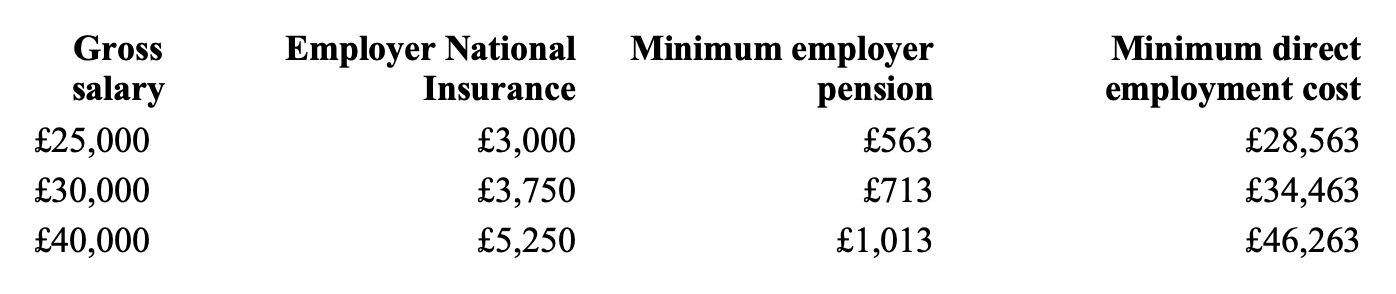
These figures do not include recruitment, payroll, insurance, equipment, training, benefits or the cost of covering absence.
Actual payroll calculations can also differ slightly because National Insurance and pension contributions are calculated by pay period.

Could Employment Allowance Reduce the Cost?
Employment Allowance can reduce an eligible employer’s annual employer National Insurance liability.
For 2026/27, the maximum Employment Allowance is £10,500.
For a small employer, this could offset some or even all of the employer National Insurance shown in the examples above.
However, Employment Allowance should not be assumed automatically. Eligibility depends on the circumstances of the business.
For example, a limited company cannot normally claim if it has only one director and that director is the only employee liable for employer National Insurance. The position can change when an additional employee is hired and paid above the relevant threshold.
Connected companies and businesses with more than one payroll may also need to consider which entity or payroll claims the allowance.
Before excluding employer National Insurance from your recruitment budget, check that your business is eligible and that the allowance has not already been used elsewhere.
Remember Paid Holiday
Almost all workers are legally entitled to 5.6 weeks of paid holiday each year.
For someone working five days a week, this normally means at least 28 days of paid annual leave. Bank holidays can be included within this entitlement.
For an employee receiving a fixed annual salary, paid holiday is generally already included within the salary figure. It should not simply be added to the salary again.
However, holiday can still create an indirect cost.
You may need to:
Arrange temporary cover.
Pay overtime to another employee.
Reduce business capacity during the absence.
Delay work or turn away customers.
Build additional capacity into the team.
For hourly, part-year or irregular-hours workers, the calculation and payment of holiday entitlement can require additional care.
Budget for Sickness and Other Statutory Leave
Employees may become entitled to Statutory Sick Pay and other statutory payments depending on their circumstances.
Maternity, paternity, adoption, shared parental, neonatal care and bereavement leave can also affect payroll and cash flow.
Some statutory payments can be recovered from HMRC in full or in part, while others cannot. The business may also choose to offer contractual benefits above the statutory minimum.
A sensible recruitment budget should therefore include a contingency rather than assuming the employee will work every planned hour throughout the year.

Add Recruitment and Onboarding Costs
The cost of finding and preparing the right employee can vary considerably.
Potential recruitment and onboarding costs include:
Job advertising.
Recruitment agency fees.
Interview time.
Employment contracts and HR support.
Background or qualification checks.
Initial training.
Uniforms and protective equipment.
Tools, machinery or specialist equipment.
A laptop, monitor or mobile phone.
Software licences and cloud subscriptions.
A desk or additional workspace.
Vehicle and travel costs.
Management and supervision time.
Some of these are one-off costs, while others will continue every month.
A role requiring a company vehicle, specialist machinery or extensive training could cost significantly more than an office-based employee on the same salary.
Do Not Overlook Employers’ Liability Insurance
Most businesses must obtain Employers’ Liability insurance as soon as they become an employer.
The policy must normally provide cover of at least £5 million from an authorised insurer. It helps protect the business if an employee becomes ill or is injured because of their work.
The cost of the policy will depend on factors such as your industry, number of employees, payroll and the level of risk involved in the work.
A construction or manufacturing business may face a different premium from a professional services business.
Allow for Payroll Administration
Once you employ someone, payroll becomes a regular legal and administrative responsibility.
You will need to:
Calculate gross and net pay.
Deduct PAYE Income Tax and employee National Insurance.
Calculate employer National Insurance.
Process pension contributions.
Provide payslips.
Report payroll information to HMRC.
Record statutory payments.
Manage starters and leavers.
Complete year-end payroll procedures.
Keep accurate employee and payroll records.
You must normally register as an employer with HMRC before the first payday. HMRC does not normally allow registration more than two months before you start paying employees.
Some businesses run payroll internally using payroll software. Others outsource it to reduce the risk of errors and free up management time.
PJE offers a payroll service covering payslips, PAYE, National Insurance, statutory payments, pension administration and payroll reporting.
Employee or Subcontractor?
Some businesses consider using a self-employed subcontractor instead of hiring an employee.
This can offer flexibility, but employment status is not simply a choice made by the business or worker. It depends on the real contractual and working relationship.
Factors can include:
Who controls how, when and where the work is completed.
Whether the individual can provide a substitute.
Who provides equipment.
How the individual is paid.
Whether there is an ongoing obligation to offer and accept work.
Whether the individual is genuinely operating an independent business.
HMRC’s employment status tool can help assess whether someone should be treated as employed or self-employed for tax purposes. HMRC states that employment status is determined by the relevant facts rather than personal preference.
Incorrectly treating an employee as self-employed could lead to unpaid PAYE, National Insurance, interest, penalties and employment law issues.

A First Employee Cost Checklist
Before agreeing a start date, work through the following steps.
1. Calculate the Complete Annual Cost
Include salary, employer National Insurance, pension contributions, payroll, insurance, equipment, software, training and likely cover costs.
2. Check Employment Allowance
Confirm whether your business is eligible and whether any of the allowance has already been used.
3. Review Cash Flow
Consider when the employee will start generating additional revenue or releasing capacity. The cost begins from the first payday, but the financial benefit may take longer to appear.
4. Confirm Employment Status
Decide whether the role is genuinely employment, self-employment or another form of engagement based on the working arrangements.
5. Register as an Employer
Complete the HMRC registration before the employee’s first payday and obtain your PAYE references.
6. Set Up Payroll
Choose suitable payroll software or appoint a payroll provider. Agree the pay frequency and collect the information needed for the employee’s first payroll.
7. Meet Pension Duties
Choose an appropriate pension scheme, assess the employee and complete the required communications and declarations.
8. Arrange HR and Insurance
Put appropriate employment terms, policies, records and Employers’ Liability insurance in place.
Can the Business Afford the Role?
The final question is not simply whether the business has enough cash to cover next month’s salary.
Consider:
How much additional revenue must the employee help generate?
What gross profit will that revenue create?
How long will training and onboarding take?
Is demand consistent throughout the year?
Will the role free the owner to focus on higher-value work?
What happens if sales are lower than expected?
Does the business have enough working capital to support the role during quieter months?
A £30,000 salary could represent a minimum direct employment cost of approximately £34,463 before Employment Allowance and other costs. Once recruitment, equipment and administration are included, the first-year cost could be higher.
A cash flow forecast can show how the role affects the business month by month and help you make the decision with greater confidence.

How PJE Can Help
Hiring an employee should support your business rather than create unexpected financial or administrative pressure.
At PJE Accountants & Advisors, we can help you:
Calculate the full cost of a proposed employee.
Build the new role into your budget and cash flow forecast.
Register the business as an employer.
Set up and manage payroll.
Calculate PAYE and National Insurance correctly.
Administer workplace pension contributions.
Review Employment Allowance eligibility.
Support you with HR records, policies and remuneration planning.
Our payroll, Human Resources and business planning services give small and medium-sized businesses access to practical support before and after their first employee joins.
Planning your first hire? Contact the PJE team for a clear calculation of the likely cost and support setting up payroll correctly from the first payday.
Posted - 1 September 2026
This article provides general information only. Employment, payroll, pension and tax responsibilities depend on the circumstances of the business and employee.